
The Pros and Cons of Professional Studio vs Remote Podcast Recording
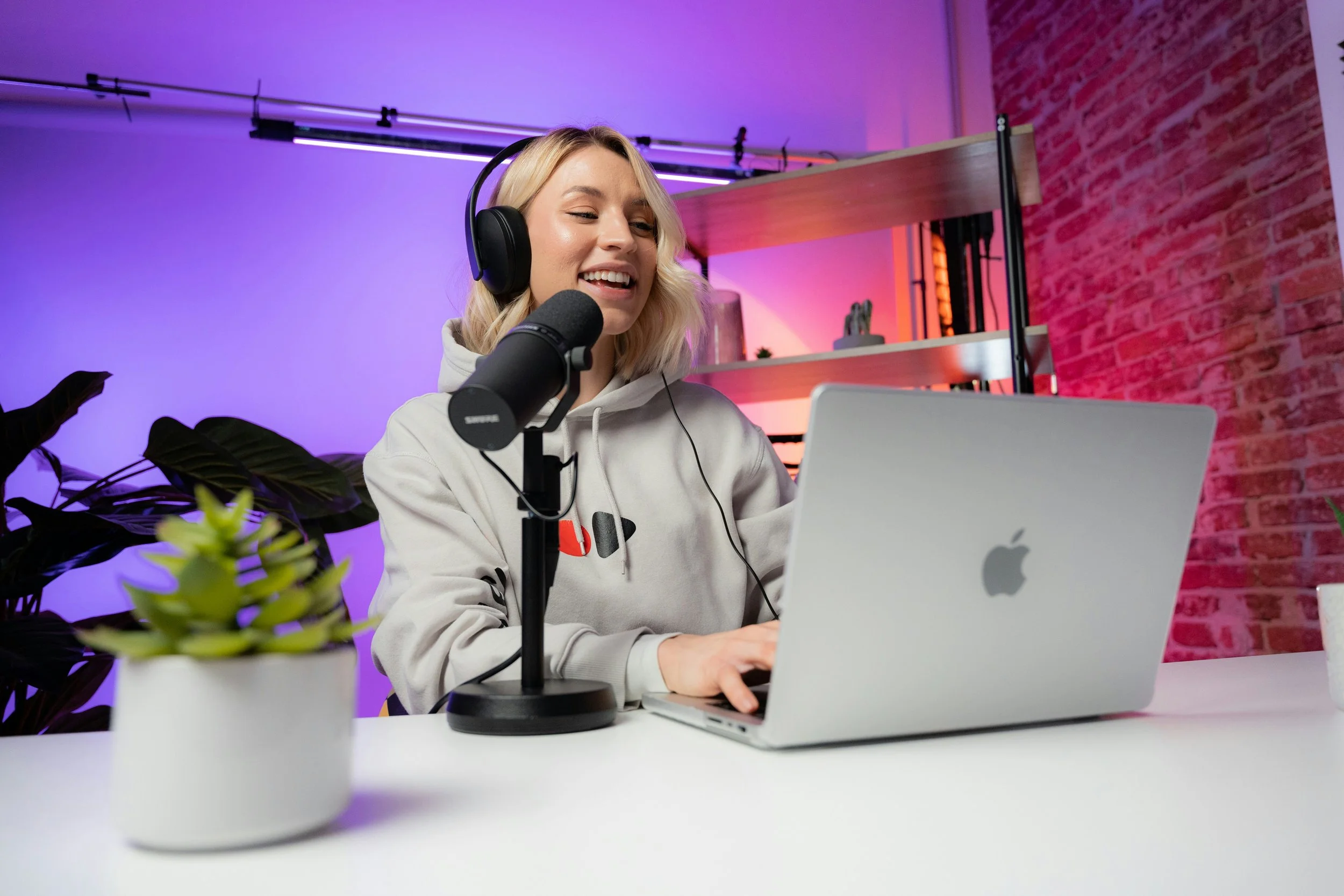
In 2020, podcast producers became experts at remote podcast recording very quickly. But there are still some very good reasons to choose a professional studio over remote - and vice versa.
Let’s break down the pros and cons of each option.
Pros of recording a podcast in a professional studio
You’ll record high-quality video
If your podcast has a large video audience, a professional studio with multiple cameras (and therefore camera angles) and professional lighting is the way to go.
Let’s say you don’t record entire podcast episodes on video, but you do use still photos and video snippets for marketing. A studio will still deliver better photos and videos, principally because pro equipment is dramatically better than laptop cameras.
The audio will be cleaner
You can certainly buy the exact same audio equipment for your home or office that you would find in a professional recording studio, especially at today’s prices. But the acoustical treatment in a professional studio will (usually) capture the best audio free of reverberation and noise.
This will reduce the amount of audio processing required by your producer/editor. But they’ll still have to edit out every “um” and “like” for a great listening experience. (Here’s a comprehensive list of what podcast producers do.)
You’ll be treated to excellent hospitality
A great studio will provide a high level of customer service and in-person amenities you simply can’t get when recording remotely. (As much as I’d like to offer you complimentary sparkling or still water, I can’t. Or can I…? 🤔)
You’ll encounter few technical issues
A studio’s equipment and gear are already set up and ready for you when you arrive - zero company firewalls or device compatibility issues to worry about.
Technical difficulties might still arise, but this rarely happens.
Recording in a studio is an experience
For some people, traveling to a studio, being welcomed by name, and sitting across from their guests are part of the experience. Remote is great, but it can’t entirely replace in-person.
Cons of a recording in a professional studio
Recording in a studio is expensive
Unless you and your guests have easy access to a professional studio out in the country or woods, recording in a studio in or near a major metropolitan city is expensive. Many budgets can’t absorb the extra costs.
It disrupts the workday
Maybe you, the host, have time in your work day to walk a few blocks to a nearby studio, spend an hour recording a single podcast episode, and walk back to the office.
Your guests may not have the time nor easy proximity to a studio, which means your podcast producer needs to ensure his team has the right remote recording software and your guests have everything they need to record quality audio remotely (and kind of defeats the purpose of the host being in-studio).
Scheduling guests may be much harder
Our clients’ podcast guests have extremely tight schedules. Some travel fairly often. Your guests may, too.
As a result, you may shrink your pool of available guests quite drastically.
Pros of remote podcast recording
Remote recording is less expensive
Recording at work or at home is obviously less expensive than renting time in a professional studio. But you’ll also save time traveling to and from the studio, and your corporate communications team will save even more time on emails and phone calls trying to coordinate schedules with your guests.
You can capture studio-quality audio with a great headset
A high-quality podcast starts with capturing high-quality audio. And believe it or not, a great headset will capture studio-quality audio. It’s the reason we send all hosts and guests a Volubles headset, well in advance of recording.
Speaking of recording, we use professional software that records audio locally, eliminating audio dropouts and ensuring you and your guests sound like you’re in a studio rather than a home office.
Recording remotely is more convenient for everyone
In our experience, convenience is king. No one needs to drop what they’re doing and carve out time from their busy day to get to a studio. This also makes it much easier to book guests.
You’ll receive excellent customer service
Or, you should! Our producers are skilled at putting guests at ease, answering questions, troubleshooting in real time, and generally making sure everyone is relaxed and ready to record a great conversation.
You’ll have more flexibility with rescheduling
Just last week, a guest had to cancel two minutes before a scheduled podcast recording, but we were easily able to reschedule for the following day.
Cons of recording remotely
Technical and compatibility issues are common
We sometimes have to work with a guest’s IT department to resolve firewall issues, along with browser and device compatibility, that interfere with the remote recording software we use.
Because this is so common, we always host a pre-recording meeting to tackle challenges so nothing interrupts (or delays) the conversation on recording day.
Video quality suffers
This is where quality outweighs convenience. Laptop cameras are great, but people don’t know how to frame themselves so their camera captures their best angle.
Then there’s lighting. Even though it seemed like everyone was buying a ring light during the pandemic, many people don’t have one. The result: Dark lighting and unflattering shadows.
However, the biggest challenge: Video is compressed when it’s recorded remotely, making the footage less friendly for your editor. Plus the end product will have a lower resolution.
Remote podcast recording doesn’t sacrifice audio quality
Remote podcast recording is popular for a reason: It’s convenient for everyone, it saves money, and it doesn’t sacrifice quality.
As professional podcast producers, we know exactly what it takes to record quality audio, seamlessly edit recordings, and deliver turnkey episodes that are ready for distribution.
Since 2017, we have helped small businesses, grant-funded scholars, nonprofits, law firms, large corporations, and the marketing firms who collaborate with them produce exceptional podcasts. Email us at info@volubilitypodcasting.com to get the conversation started.